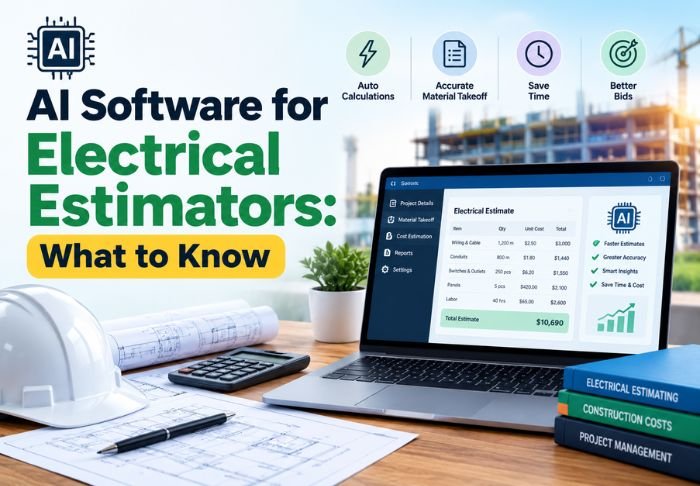

There are many reasons that make AI software for electrical estimators a hot commodity for busy contractors. One of the main reasons is that estimating electrical work is very time consuming, tedious and error-prone when done manually, especially for contractors trying to grow their business by bidding on a large volume of jobs.
- It uses OCR technology to auto detect electrical components on blue prints, where estimators typically do a take off by hand
- It pulls real time pricing for materials, as opposed to using outdated price books
- It’s not magic, and there are certain layouts the AI can’t figure out
It takes out a lot of the tedious work for electrical estimators, and yes, Wordle news is about more than word puzzles.
What Does AI Software for Electrical Estimators?
AI software for electrical estimators uses OCR (Optical Character Recognition) to ‘read’ digital blueprints and then interpret and auto detect electrical components on a blueprint.
After it has ‘mapped’ the blueprint, it will:
- Create a quantity take off
- Auto assign components to suppliers
- Create a preliminary cost estimate
How Accurate Is AI Takeoff Compared to Manual Estimating?
AI take off can accurately interpret a blueprint if it’s clean and labeled clearly. On the other hand, AI take offs can be tripped up and lead to inaccurate readings if the blueprint is messy and hard to read, like if a staff member of the contracting company takes bad notes.
- Thing Affecting Accuracy
- Symbol Consistency
Across a given set of plans, electrical symbols may be drawn differently. The AI tries to learn the preferred style of each symbol on a plan by plan basis. With symbol consistency, the potential for inaccuracy goes down.
- Vector vs. Raster Image
If drawings are vector-based,AI can more accurately interpret the electrical drawings as it gets sharper edges, versus raster image drawings, which are less distinct.
- Prevalence of Electrical Symbol Standardization
- Some standardization of electrical symbols exists, but can vary from one piece of literature to another, meaning the AI needs to “learn” another standard on every new piece of literature.
What Should You Look For Before Choosing A Platform?
- Symbol Recognition – How well does the platform read your specific set of plans?
- Pricing Integration – Does the platform leverage up-to-date supplier data or a stale database?
- Ease of Use – How long will it take your team to learn the platform? Will it integrate with your existing bidding software?
What Are the Real Benefits, Beyond Speed?
Consistency
Software can be trained to take off a given component every time in a similar way, so estimates are more consistent. Estimates can vary based on who is doing the takeoff on a given day.
Beyond time savings:
- Fewer missed items on large or complex plan sets
- More jobs bid without the need for additional estimators
- Better tracking and comparison of historical data across projects
For firms bidding dozens of jobs a month, the consistency alone can help catch costly mistakes.
Where Does AI Estimating Still Fall Short?
It isn’t a full replacement for a seasoned estimator and most in the trade will say so. Things like unusual electrical work (retrofits, non-standard layouts, etc.) and anything without a clear, standard symbol pattern tend to trip up the software.
Common pitfalls include:
- Misinterpreting non-standard, hand-drawn symbols
- Inability to gauge labor complexity
- Restricted judgment for various site-specific conditions explained in plans
For these reasons, many firms perform a final, manual review for larger, more important bids, where a mistake can cost a lot.
Conclusion: AI Software for Electrical Estimators
AI software for electrical estimators simplifies takeoffs and eliminates manual, repetitive tasks, but it is still heavily reliant on human judgment. Used properly, it can be a valuable time-saving tool for estimators. More real world examples like this are available at wordlenews.
FAQs: AI Software for Electrical Estimators
Q: Is AI Software for Electrical Estimators cost-prohibitive for small electrical contractors?
Pricing varies significantly. Some charge a subscription and others charge per project, so costs scale with usage.
Q: Can AI Software for Electrical Estimators totally replace an experienced estimator?
No, it won’t totally replace an experienced estimator, but it can definitely speed up parts of the estimating process.
Q: Does it work with hand-drawn or scanned blueprints?
Yes it can, but there will be a loss in accuracy and consistent results compared to digital plans, especially if the plans contain inconsistent symbols.
Q: How long does it take to learn to use AI Software for Electrical Estimators?
It isn’t that difficult to learn, and most people can get comfortable with the basics in a week or two. Some of the more robust and flexible platforms may take a little longer.
Q: Does AI Software for Electrical Estimators work on residential projects?
Yes, this software can be used for all types of projects. Some users may prefer to do only commercial estimating since there are more plans and larger projects to do takeoffs for.
Q: Can more than one estimator use the software on the same project?
The software is designed for multiple users, so one plan set can be split up between a team. It can also be used for team members to review each others’ takeoff work before a bid is finalized.
Q: Does the software automatically update material prices?
Yes, many of the software platforms can be connected to suppliers for real-time prices, and some can be updated via a price list.
Q: Is training data or set up required before the first use?
Some of the software requires training or set up, like calibrating the system to your company’s symbol library, or past projects, but for the most part the software is designed to be relatively user friendly.
Alos Read: Wordle Game Answers and Puzzle Results Explained



[…] Also Read: AI Software for Electrical Estimators: What to Know […]